BigCell: Generating Gigapixel Whole-Slide Images
NeurIPS 2026
Srikar Yellapragada1
Alexandros Graikos1
Zilinghan Li2
Kostas Triaridis1
Tarak Nath Nandi2,3
Karen Bai1
Beatrice Knudsen4
Tahsin Kurc1
Prateek Prasanna1
Rajarsi R. Gupta1
Ravi K. Madduri2,3
Joel Saltz1
Dimitris Samaras1
1Stony Brook University, 2Argonne National Laboratory, 3University of Chicago, 4University of Utah
We present BigCell, the first approach to generate coherent whole-slide histopathology images at gigapixel resolution. Existing histopathology generative models produce tiles of at most 1024x1024 pixels, a small fraction of a whole-slide image (WSI), while the supervision that exists at scale (pathology reports and slide-level labels) describes the entire slide. BigCell trains a flow-matching transformer at 2048x2048 pixels on over 120,000 publicly available WSIs, and generates coherent images of up to 32,768x32,768 pixels. We also propose the first text-to-image synthesis at 8k resolution, and show that synthetic data improves slide-level few-shot classification by up to 18%.
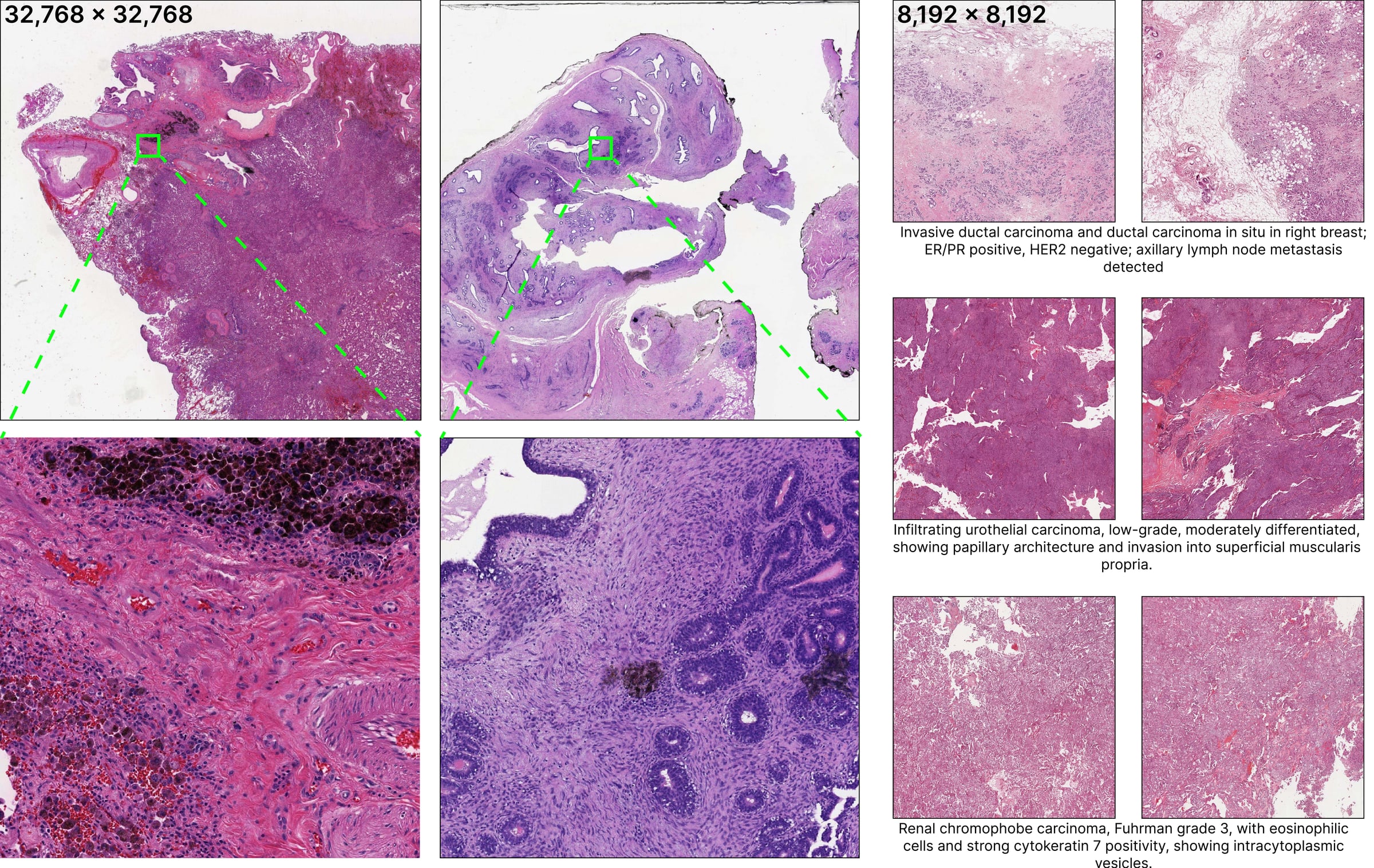
All images above are synthetic. Left: 32,768x32,768 images generated by BigCell, with 2048x2048 crops showing realism both at the macro-scale and at the cellular level. Right: two 8192x8192 images generated per pathology report.
Method
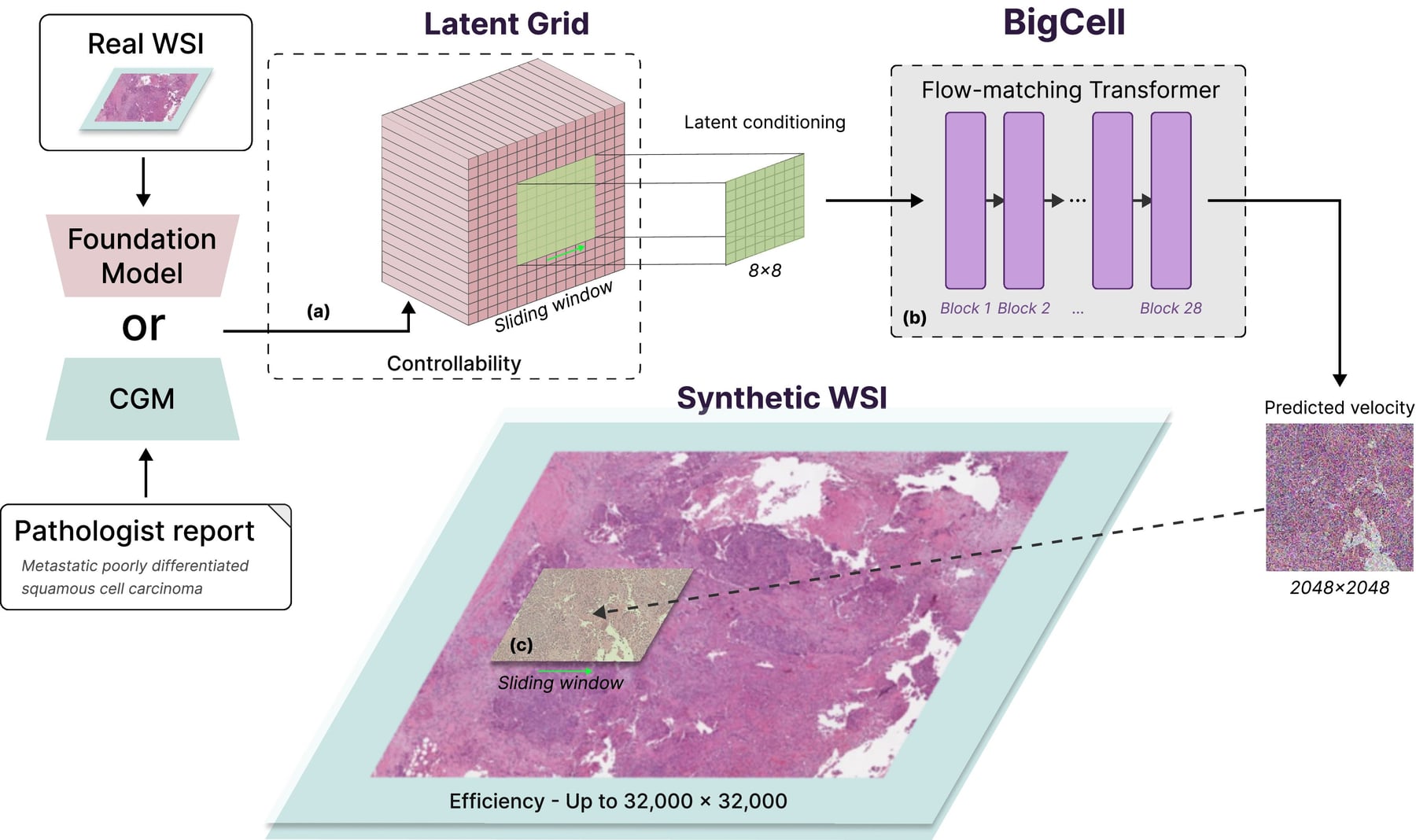
(a) Conditioning. We control generation with a dense grid of UNI-2 embeddings, one per 256x256 patch. The grid is either extracted from a real WSI, or sampled from a pathology report by our conditioning generation model (CGM), a flow-matching transformer that operates directly in the UNI representation space.
(b) Tile generator. BigCelltile is a flow-matching transformer that generates 2048x2048 tiles in the latent space of the FLUX.2 VAE, conditioned on an 8x8 grid of UNI-2 embeddings. We train it progressively from 256x256 up to 2048x2048 resolution.
(c) Sliding-window generation. To go beyond the native resolution, we run the tile generator on overlapping windows of the global latent canvas and average their velocities into a global velocity field at every denoising step. The conditioning grid acts as a global blueprint, dictating what tissue morphology belongs where.
Comparison at 8k resolution
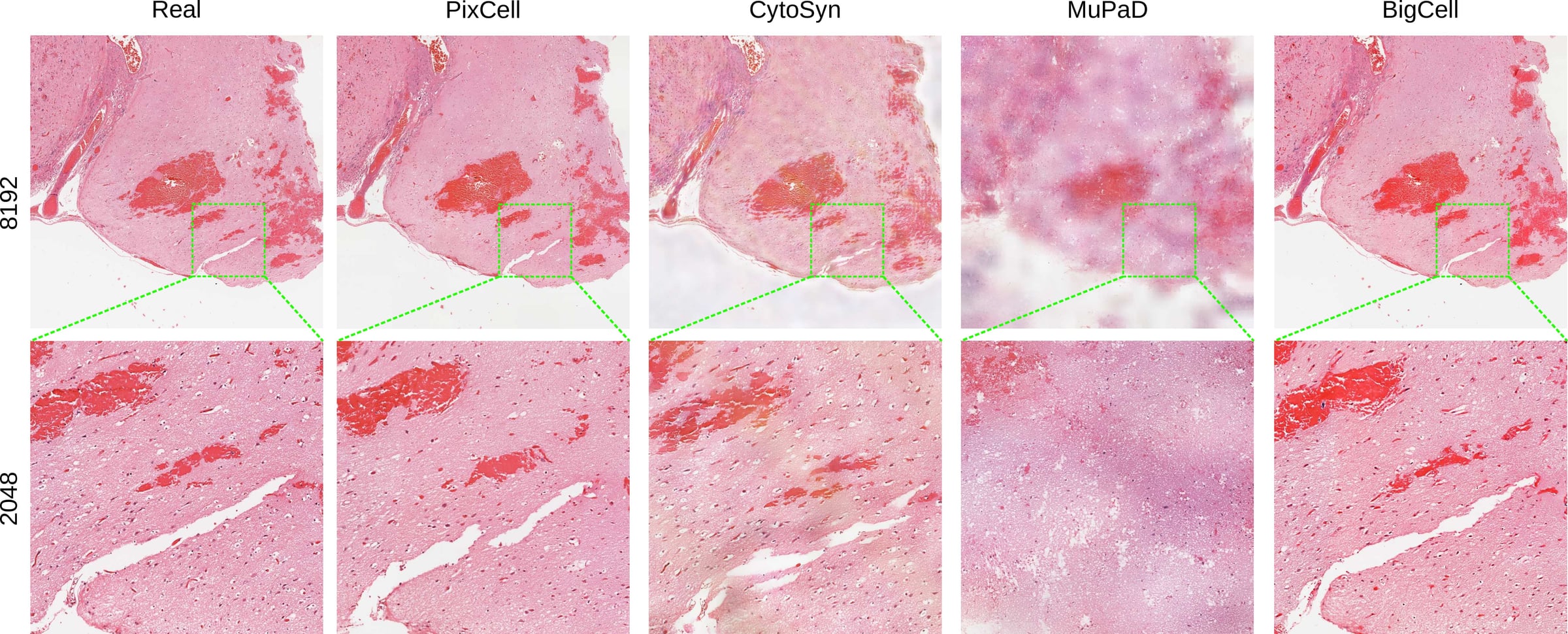
We plug prior tile generators into the same sliding-window pipeline and compare against large-image methods at 8192x8192 resolution. BigCell achieves the highest slide-level similarity to the reference images under both TITAN and MOOZY, and leads on patch-level similarity, especially on the bottom-5th-percentile (tail) metrics, indicating far fewer regions of degraded local fidelity.
| Generator | TITAN↑ | MOOZY↑ | V2mean↑ | V25th↑ | H1mean↑ | H15th↑ |
|---|---|---|---|---|---|---|
| PixCell | .941 | .900 | .778 | .632 | .667 | .509 |
| CytoSyn | .929 | .864 | .753 | .502 | .640 | .457 |
| MuPaD | .646 | .755 | .462 | .258 | .342 | .196 |
| LRDM | .531 | .693 | .513 | .334 | .395 | .247 |
| ZoomLDM | .708 | .801 | .646 | .464 | .477 | .325 |
| BigCell | .956 | .973 | .869 | .737 | .735 | .586 |
Using MedGemma-4B to write reports for generated and reference images, BigCell's generations agree with the reference on the organ in 69% of cases and on the diagnosis in 46%, compared to 63% and 42% for the next best model, PixCell.
Efficient gigapixel generation
Generating a 32k image requires denoising hundreds of overlapping windows at every step. Not all windows need the same effort: complex regions rely heavily on the conditioning, while background or homogeneous stroma are mostly shaped by the unconditional prior. We measure each window's importance as the difference between its conditional and unconditional velocities, which is available for free with classifier-free guidance:
At each step we only denoise the top- most important windows, and reuse cached velocities for the rest. This is training-free, controlled by a single hyperparameter , and focuses compute on tissue rather than background.
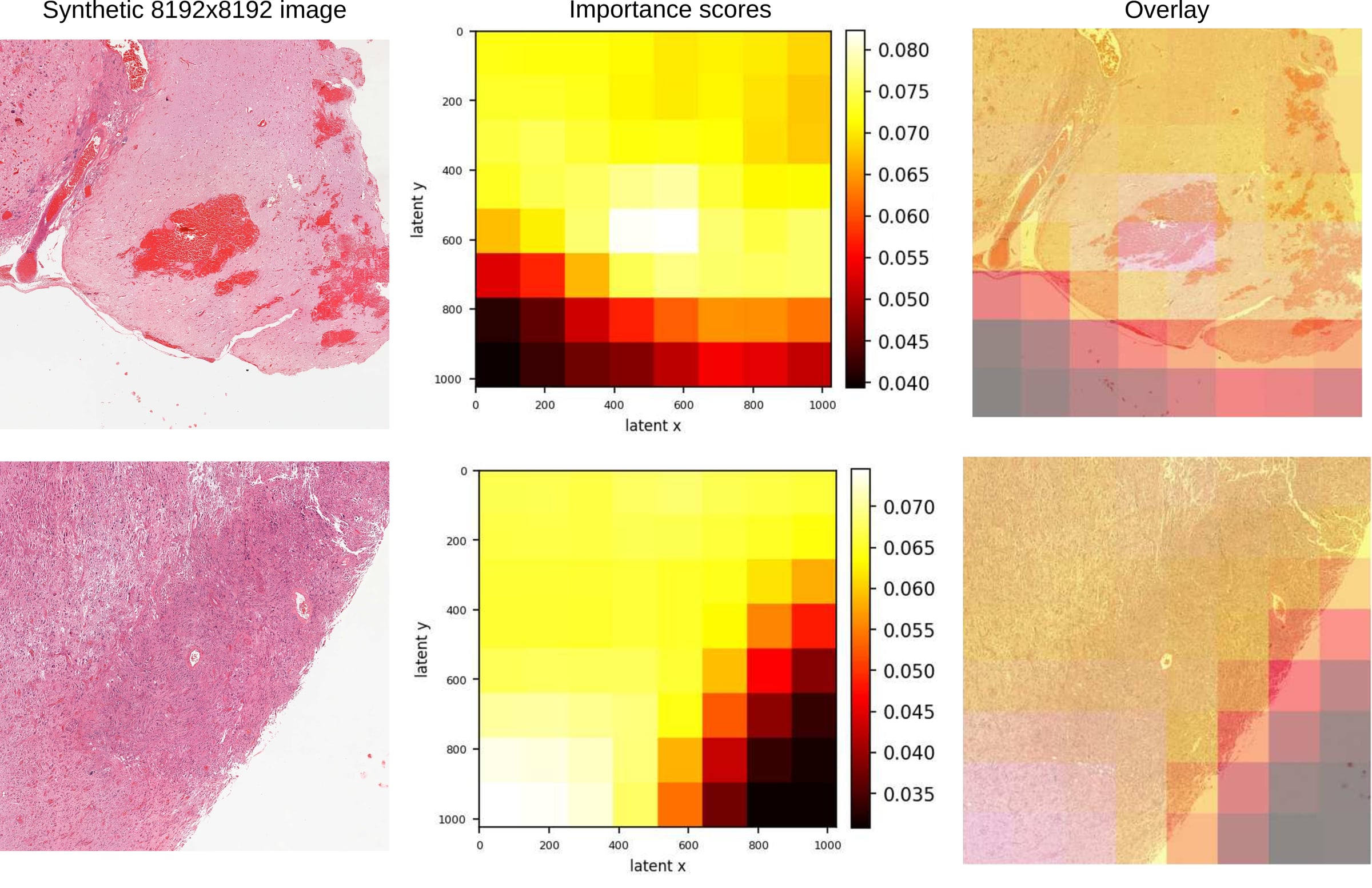
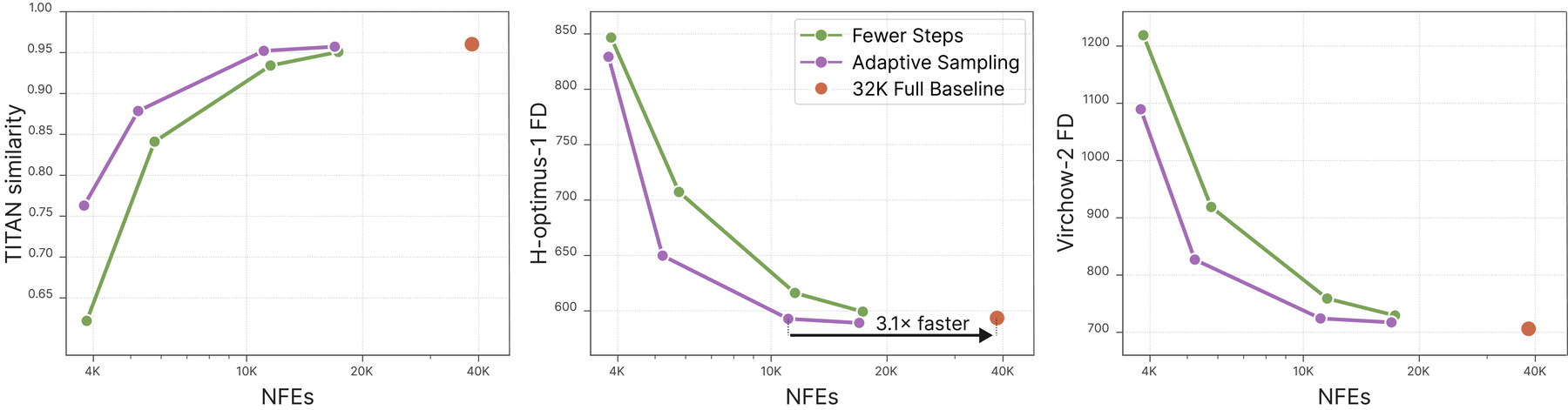
Adaptive scheduling beats simply using fewer sampling steps at every compute budget. At it matches full-compute quality (TITAN similarity 0.951 vs 0.957) with a 3.1x speedup, reducing 32k generation from 15.6 hours to 4.97 hours on a single GPU.
Text-to-image generation at 8k
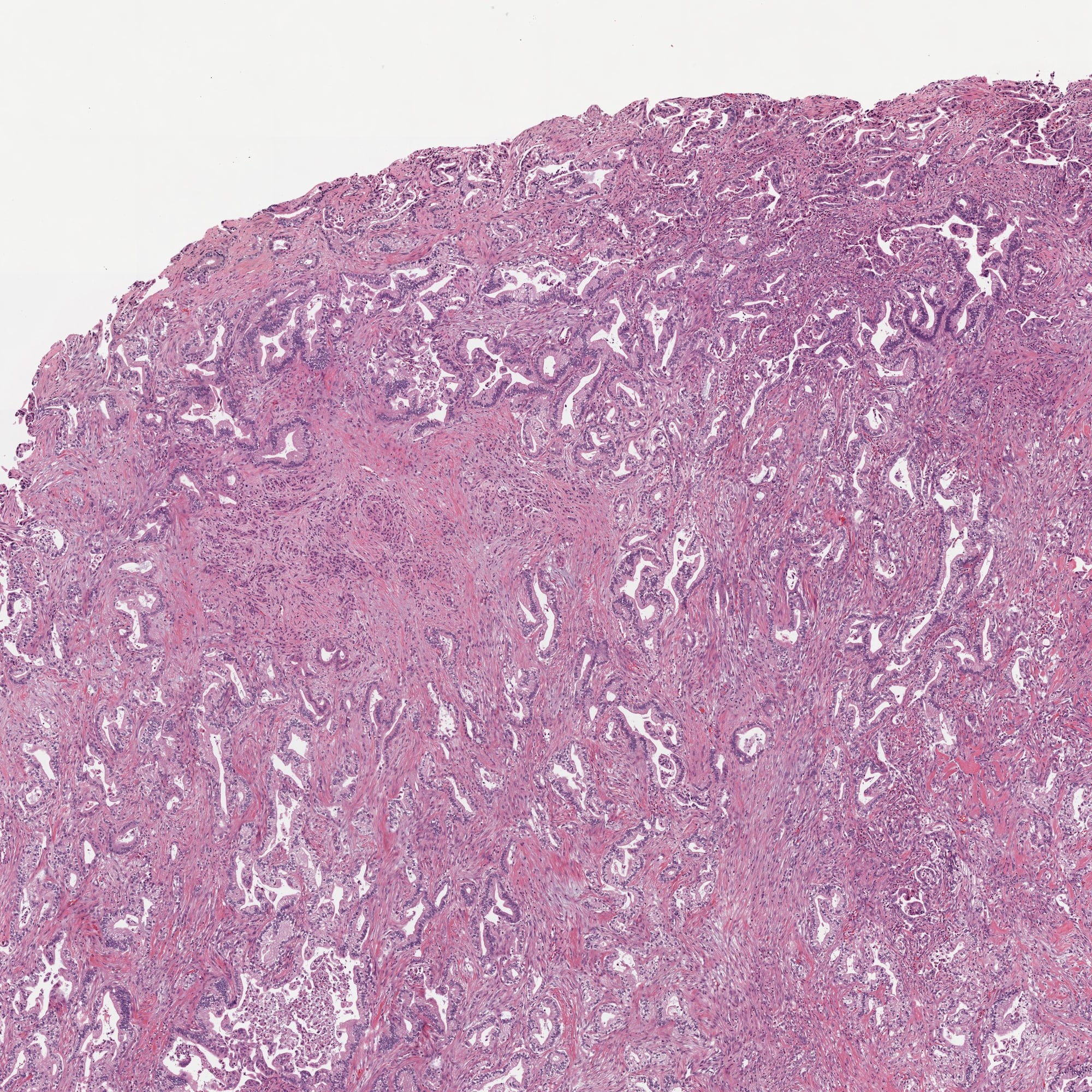
Synthetic 8192x8192 image generated from a pathology report, showing extensive pancreatic ductal adenocarcinoma.
Combining the CGM with BigCell, we generate 8192x8192 images directly from free-form pathology reports. On 150 held-out reports, generated images approach the text-image alignment of real paired data under both TITAN and PRISM, and match real data on TITAN recall@5.
| TITAN Sim | TITAN R@1 | TITAN R@5 | PRISM Sim | PRISM R@1 | PRISM R@5 | |
|---|---|---|---|---|---|---|
| Real data (paired) | 0.551 | 0.211 | 0.655 | 0.499 | 0.148 | 0.430 |
| BigCell | 0.487 | 0.169 | 0.655 | 0.454 | 0.106 | 0.387 |
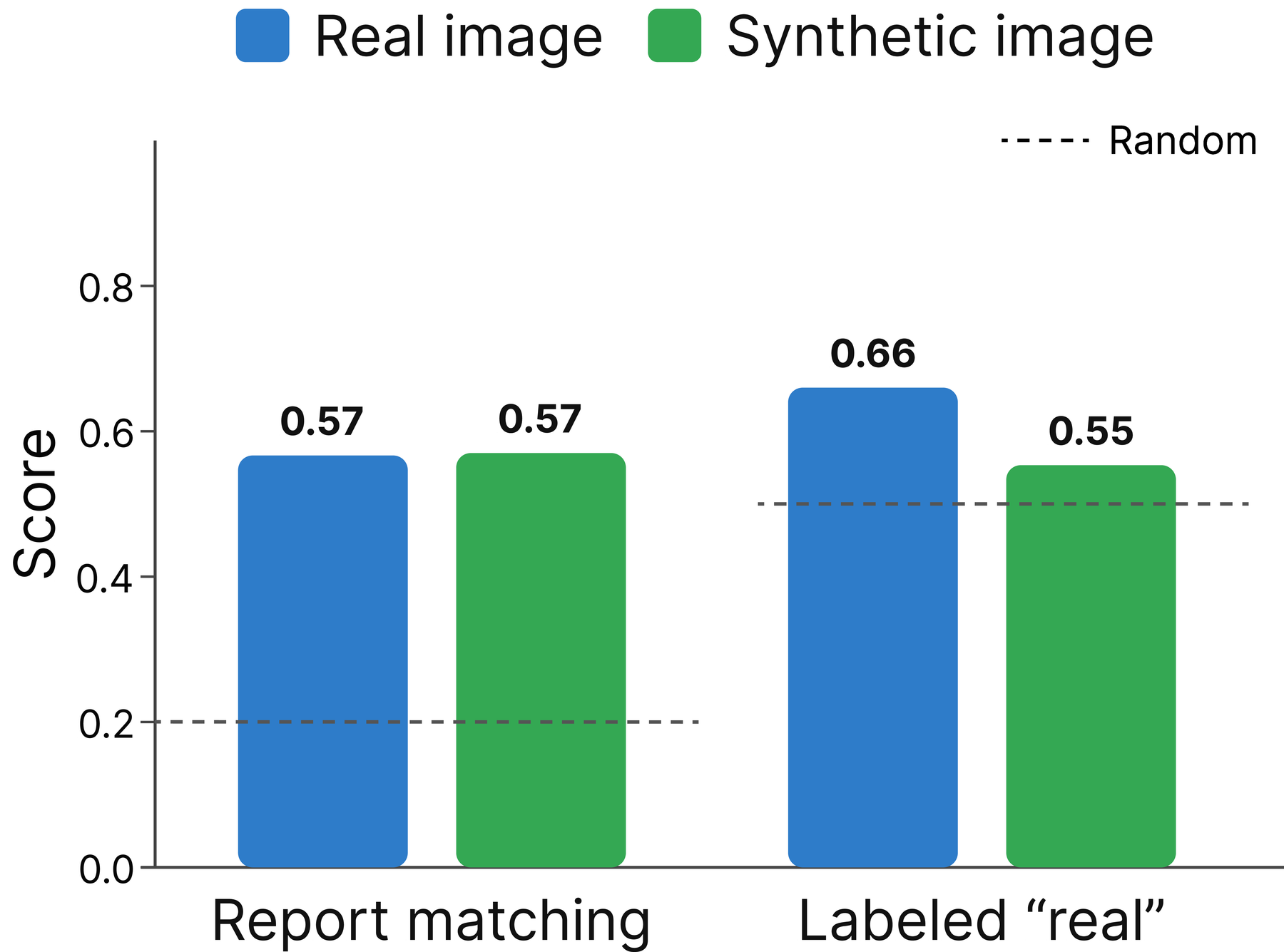
Pathologist evaluation. Board-certified pathologists match synthetic images to their source reports as accurately as real ones (0.57 for both). When asked to tell real from synthetic, they labeled synthetic images as real 55% of the time, and their inter-rater agreement was at chance (Cohen's κ = 0.020).
Synthetic data augmentation
The CGM also enables class-consistent data augmentation: we noise the UNI grid of a real training image, denoise it under a class-specific synthetic report, and render it with BigCell. Augmenting the real training set improves few-shot classification on TCGA-UT-8K and PANDA across all shot counts, with relative gains of up to 18% on PANDA (which is held out from CGM training).
| Shots | Split | TCGA-UT-8K Bal-acc | TCGA-UT-8K AUROC | PANDA κ | PANDA Bal-acc |
|---|---|---|---|---|---|
| K=1 | Real | .696 | .970 | .405 | .304 |
| +Syn | .751 | .979 | .442 | .315 | |
| K=2 | Real | .761 | .982 | .480 | .336 |
| +Syn | .785 | .984 | .531 | .358 | |
| K=4 | Real | .801 | .987 | .493 | .375 |
| +Syn | .804 | .987 | .583 | .402 |
32k samples
Synthetic 32,768x32,768 images generated by BigCell, with progressive zoom-in crops. Full-resolution pyramidal TIFFs of more samples are available on figshare and can be viewed interactively with QuPath.
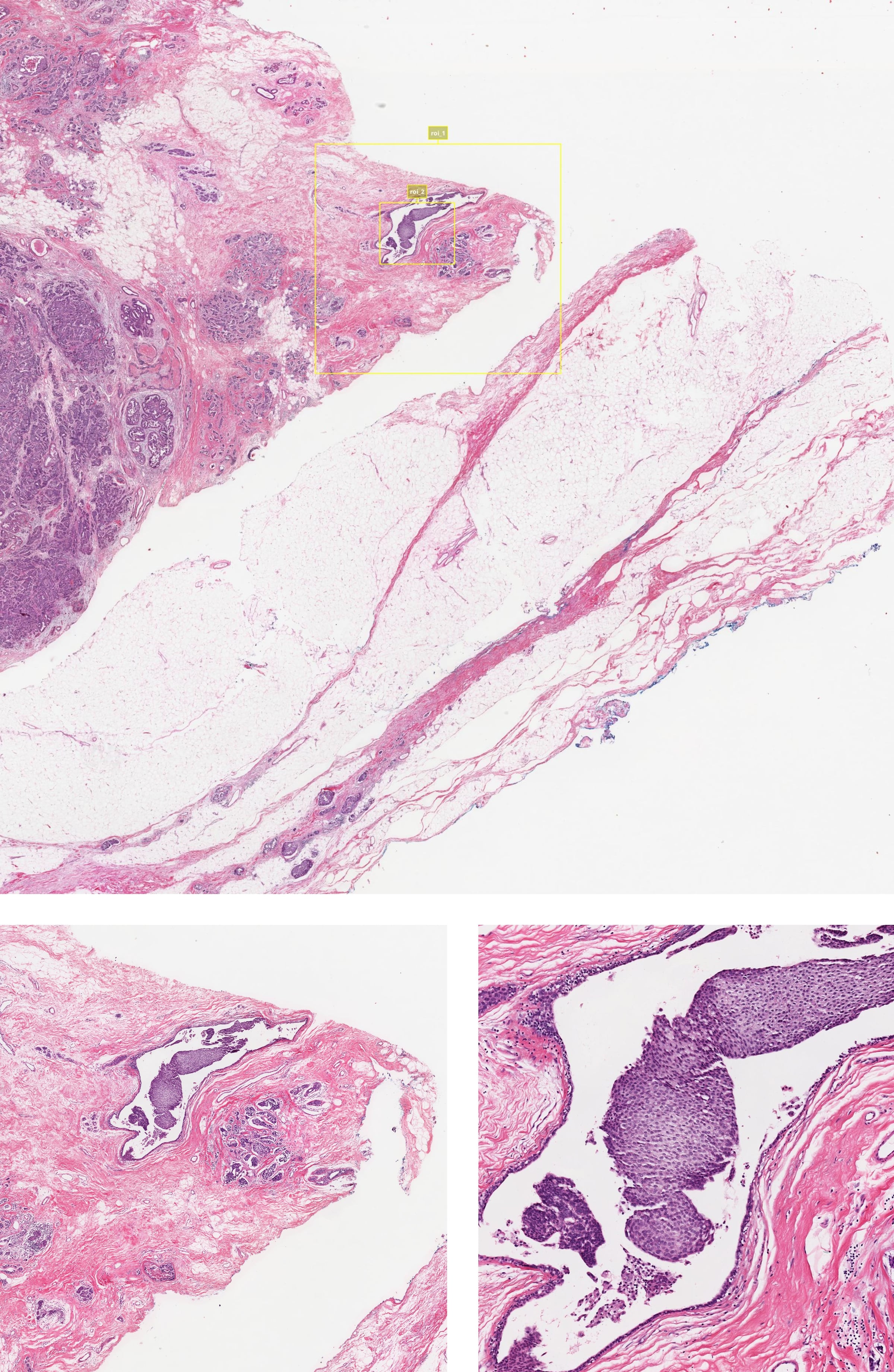
Breast tissue
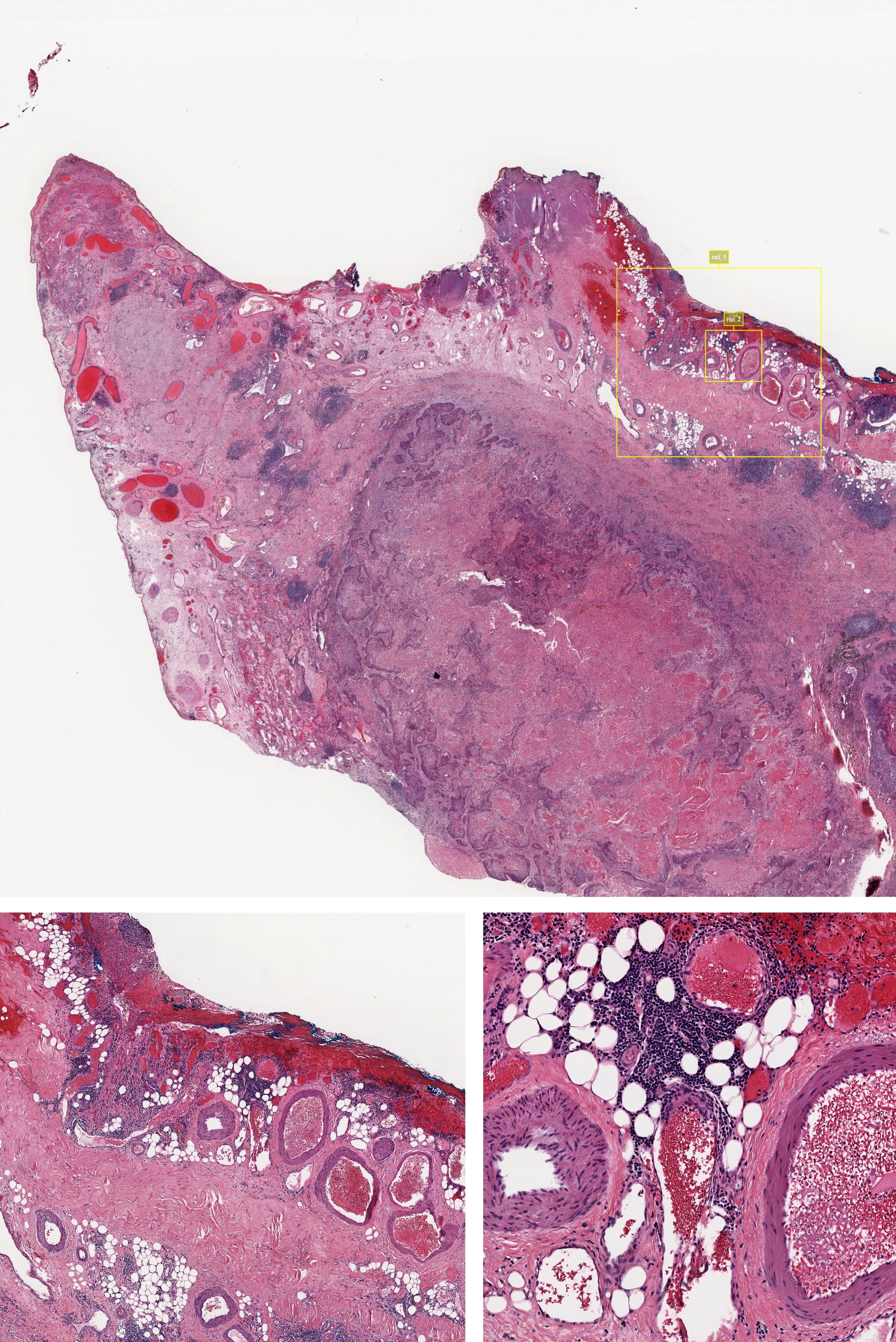
Lung tissue
Citation
@misc{yellapragada2026bigcell,
  title={BigCell: Generating Gigapixel Whole-Slide Images},
  author={Srikar Yellapragada and Alexandros Graikos and Zilinghan Li and Kostas Triaridis and Tarak Nath Nandi and Ji Dong K Bai and Beatrice Knudsen and Tahsin Kurc and Prateek Prasanna and Rajarsi R. Gupta and Ravi K Madduri and Joel Saltz and Dimitris Samaras},
  year={2026},
  eprint={2610.14261},
  archivePrefix={arXiv},
  primaryClass={cs.CV},
  url={https://arxiv.org/abs/2610.14261},
}